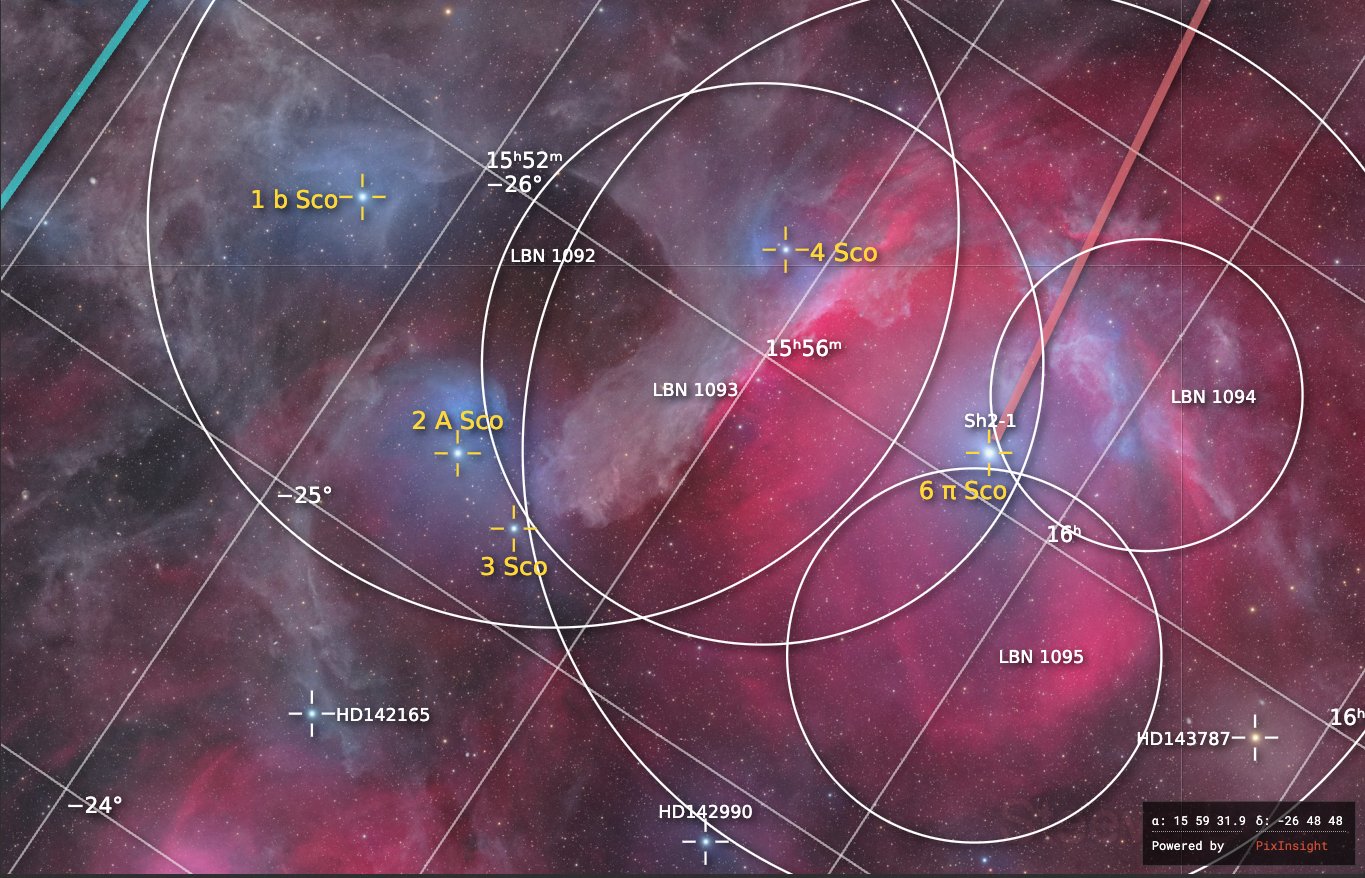
Scorpius Claw – Sh2-1 and the LBN Dust Clouds
This region sits right where the Scorpius Claw meets Antares, and it’s one I’ve wanted to image for a long time. The structural complexity here is hard to ignore: reflection nebulae, sweeping dust clouds, embedded Ha emission, and a scattering of background galaxies all sharing the same field. It was captured remotely from Swan Reach Observatories in the South Australian desert, using a Takahashi FSQ widefield refractor through the DSRO Australia team, with 18 hours and 55 minutes of total integration across Ha and LRGB.
The object
Sh2-1 is a compact reflection nebula in Scorpius, illuminated primarily by a hot B-type star. The intense ultraviolet output from that star causes the surrounding dust to scatter blue light and drives some hydrogen ionisation in the region. That said, the Ha emission here is not dominant, which keeps this firmly in reflection nebula territory rather than emission. The result is a subtler object than a pure emission target, and one that rewards restraint in processing.
What I was working towards
The main goal was to capture the interplay between the Ha and the dust in a way that felt cohesive rather than forced. That region has a real sense of depth when the two elements are balanced correctly, with the dust clouds layering into the background and the emission threading through them.
The large blue stars scattered across the field are a visual asset but a processing headache. They cast a genuine glow across the surrounding gas that I wanted to preserve, but keeping that glow from overwhelming the composition required careful handling. Push too hard and they dominate; pull back too much and you lose the atmosphere they create.
The background galaxies presented a different kind of challenge. They’re small, faint, and carrying very little colour information by the time you pull them out of the data. I resolved as much structure as I could without overprocessing, and accepted that the colour rendition on those was always going to be limited by what the data could give.
This is a region I’d happily return to with more time on it.