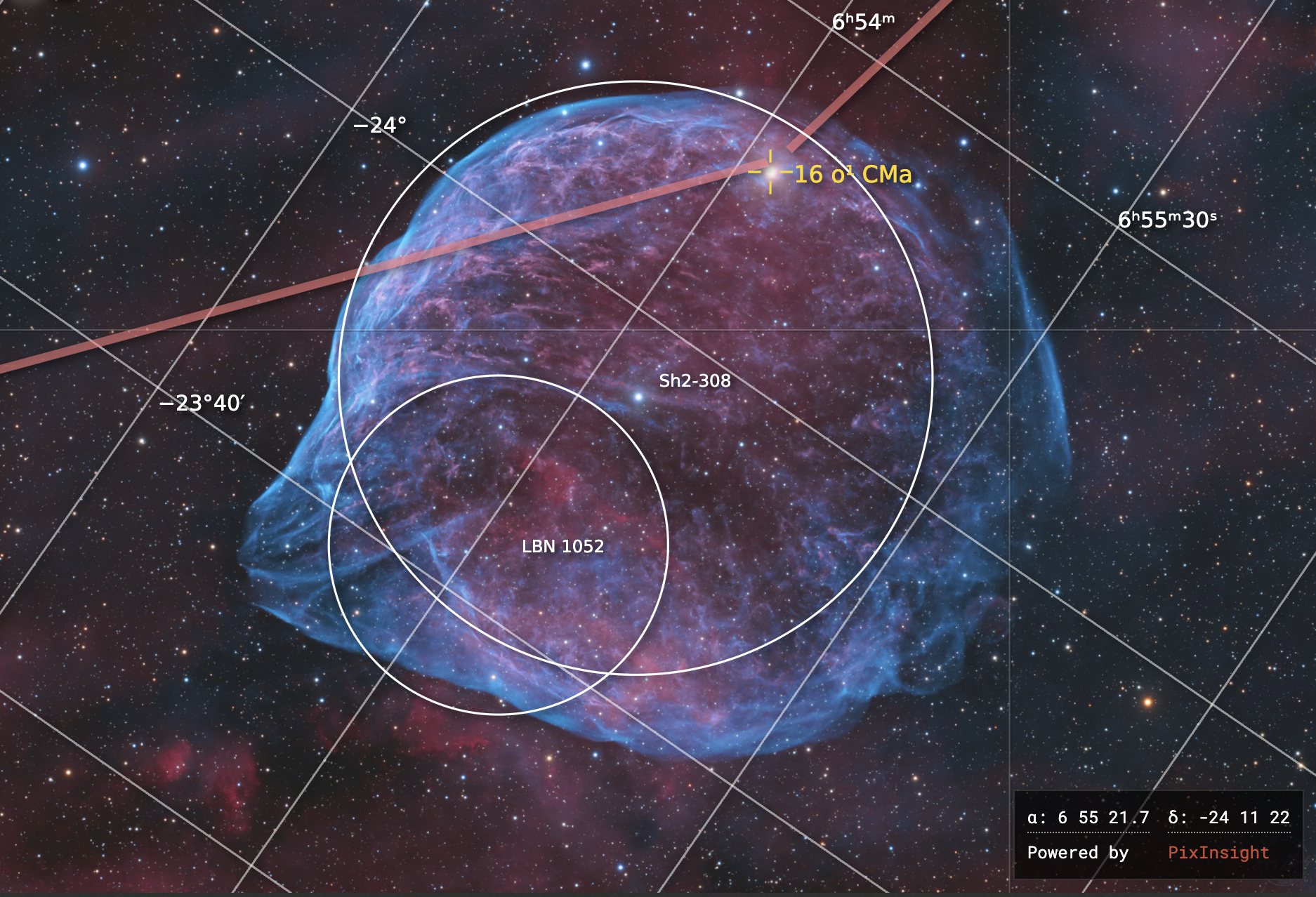
The Dolphin Head Nebula
The Dolphin Head Nebula was one of the objects that caught my attention early on in astrophotography. I imaged it back then without really knowing what I was doing in processing, and it always felt like unfinished business. This is the revisit, captured entirely from my light-polluted backyard in Melbourne under Bortle 6/7 skies.
All 27 hours of data were collected using my Askar 107 PHQ refractor and ZWO ASI 1600 MM Pro monochrome camera, with 600-second sub-exposures across both narrowband channels. Both the Ha and OIII were continuum subtracted before blending to isolate the emission lines cleanly from the star field, which matters more than usual in a region this dense with stars.
What the object is actually like
The Dolphin Head is an interesting narrowband target because the two emission channels behave very differently. OIII is reasonably bright and responds well to moderate integration. Ha is noticeably dimmer and requires more care to bring out without either losing it in the noise or blowing the brighter regions. Getting the balance between the two is where most of the processing work sits with this one.
Processing approach
The final image uses an HOO palette, with Ha mapped to red and OIII to blue and green. The three goals I set going into the processing were: show the contribution of Ha within the object itself, reveal how the Ha and OIII filaments intertwine without clipping the highlights, and keep the saturation restrained enough that the result looks natural rather than artificially vivid. There are plenty of versions of this object online that have been pushed too hard in saturation, and I wanted to go the other way.
Deconvolution was applied conservatively at 0.38 in BlurXTerminator, which is on the lower end of the scale. The Askar data held up well enough that pushing it harder wasn’t necessary and would have introduced more artefacts than detail.
Framing
Portrait orientation fits the object’s proportions more neatly on paper, but it kills the pareidolia entirely. In landscape you can actually see the dolphin, which is most of the point of imaging something called the Dolphin Head Nebula. Landscape it stayed.