The Vulcan Nebula (WPS46)
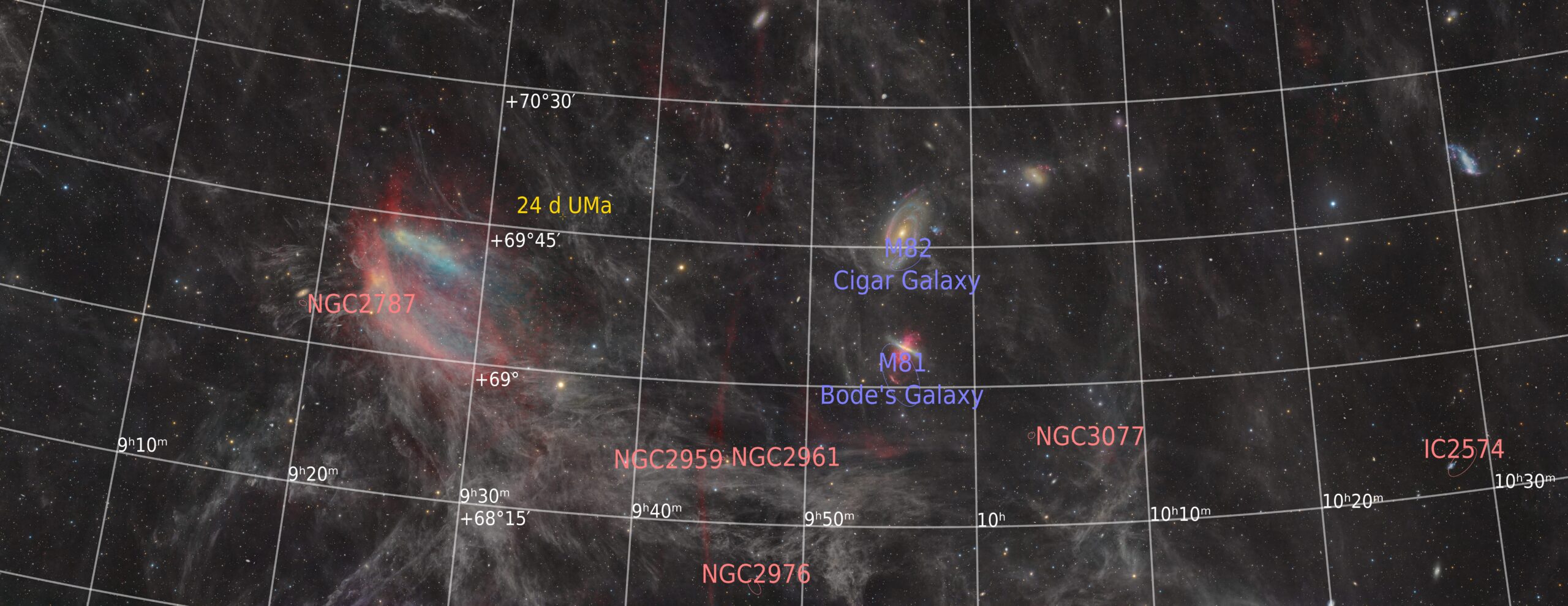
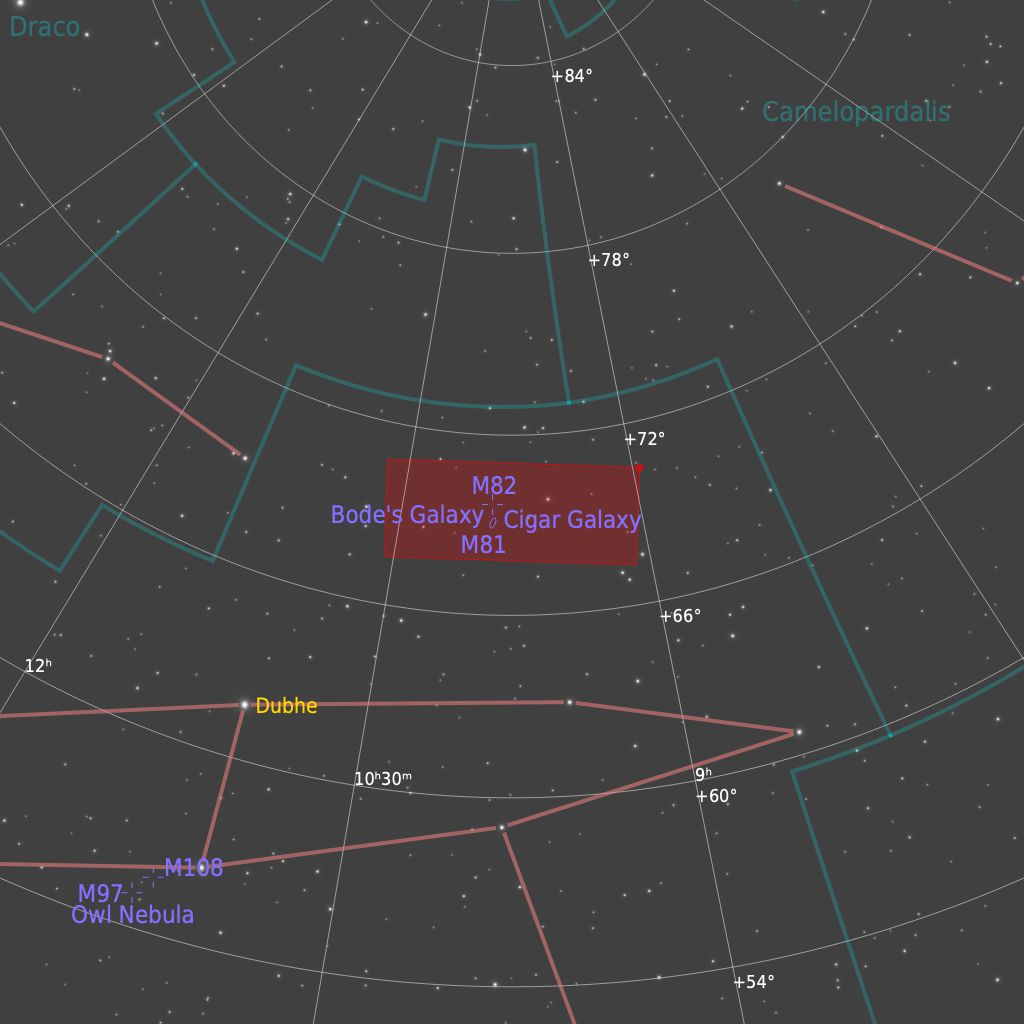
WPS46 turned up during a large-scale survey campaign at SRO, where we were using a Rokinon 135mm lens with a dual narrowband filter to search for extensive OIII structures associated with the Ursa Major SNR. After scanning a lot of sky without much to show for it, a faint blue-green signal appeared near M81 and M82.
The initial read was uncertain. It had the look of an HII or ISM region rather than the SNR we were hunting for, so we went deeper to get a clearer picture. Further research confirmed that WPS46 had been documented in the WHAM survey of H-alpha enhancements at high galactic latitudes, and a handful of recent Astrobin images had captured it as well. Its central ionising star, TYC 4376-968-1, is neither a hot dwarf nor a hot sub-dwarf, which leaves the true nature of the nebula an open question.
When I pulled deeper FSQ106 data, a second surprise emerged: a large H-alpha filament crossing the field, part of the Ursa Major SNR we had originally set out to find.
The collaboration
The project combined data from several systems. Patrick Sparkman and Tarun Kottary operated the FSQ106 widefield systems. Curtis Morgan and Bray Falls used the DR350 for detailed close-up work on the nebula. Tim Schaeffer coordinated the framing strategy, making sure all the fields aligned across systems. I processed the widefield mosaic; Bray Falls handled the close-up images.
Beyond WPS46 itself, the field contains complex IFN, the starburst pair M81 and M82, extended features from the Ursa Major SNR, and a scattering of background galaxies worth exploring in the full-resolution version.
Credits
Tim Schaeffer (coordination), Bray Falls (close-up processing), Steeve Body (widefield processing), Patrick Sparkman, Tarun Kottary, Curtis Morgan.