Messier 106 (NGC 4258)
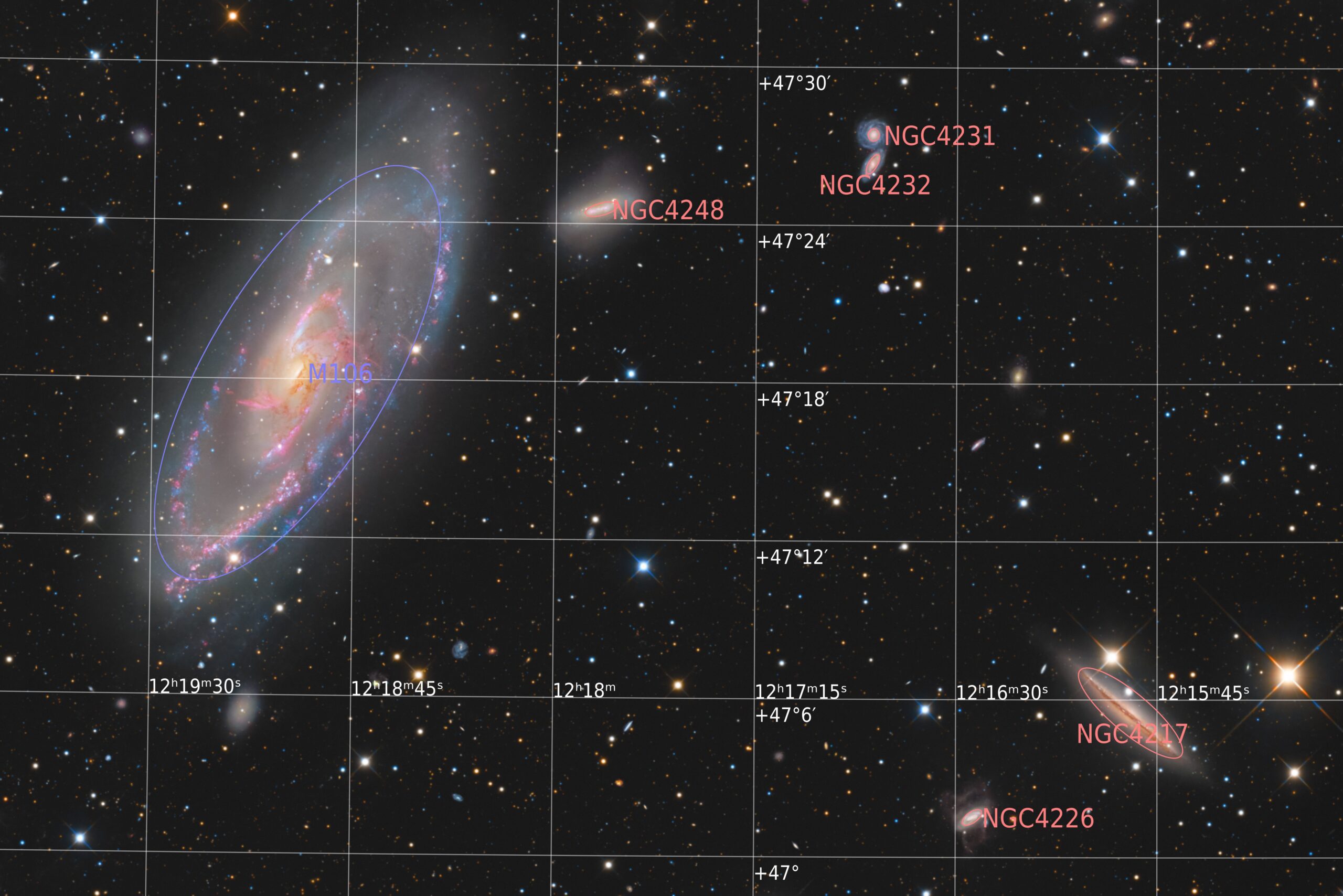
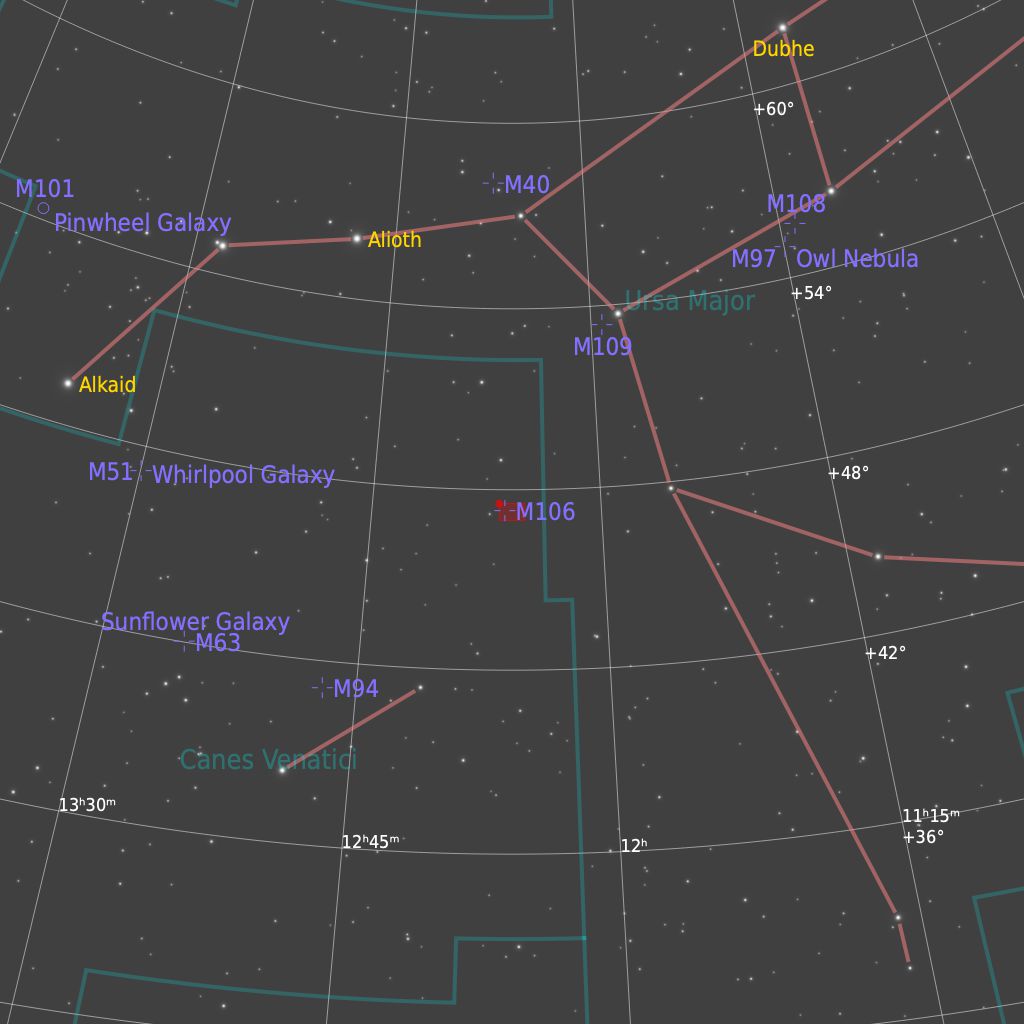
M106 is an intermediate spiral galaxy in Canes Venatici, about 23 million light-years away and roughly 135,000 light-years across. What makes it a compelling target is its active supermassive black hole, which drives energetic jets that produce what are sometimes called anomalous arms, large-scale outflows visible in emission line data. That combination of structure and activity made it a natural fit for a deep, multi-wavelength study.
The data
18 team members contributed over three months of imaging starting in February, followed by two months of processing. Total integration came to 566 hours and 2 minutes, including 226 hours of H-alpha, 80 hours of OIII, and 141 hours of luminance.
The H-alpha data was always going to be central to showing the outflows, but gathering more than 80 hours of OIII was the more ambitious part of the plan. After continuum subtraction to isolate the emission lines, the eastern side of M106 showed clear OIII filaments extending from the jet activity. We also incorporated professional data from Chandra (X-ray), the VLT (radio), and Spitzer (infrared) to produce a separate multiwavelength composite, available at https://deepskycollective.com/m106/multiwave.
Other objects in the field
The depth of the dataset brought out a number of other active galaxies in the field, some with outflows larger than the galaxies themselves. NGC 4217 sits prominently to the right of M106. NGC 4231 and NGC 4232, a merging pair over 350 million light-years away, are also visible, and the resulting image may be the clearest amateur capture of those two interacting galaxies to date.
Limiting magnitude came out at around m23.3 in the raw stack and m24.0 after noise reduction, roughly one magnitude shy of professional observatory standards. Steve Mandel analysed redshifts across the field and identified objects at extreme distances, the furthest sitting at around 11.7 billion light-years.
My role
I edited the final image, integrating the H-alpha, OIII, and broadband data into a single cohesive result. Balancing faint emission structures against the broader galaxy detail, while keeping the outflows readable without overwhelming the luminance layers, was the main challenge of the edit.
Credits
Tim Schaeffer (coordination), Steeve Body (processing), Adrien Keijzer (stacking, handling over 4,000 individual files), Carl Björk (assistant stacking), Steve Mandel (redshift analysis). Photographers: Ryan Wierckx, Logan Carpenter, Nicolas Puig, Paul Kent, Mike Hamende, Spencer Collins, Brian Meyers, Laurent André, Oliver Carter, Nicola Beltraminelli, Bogdan Borz, Julian Shapiro, Antoine and Dalia Grelin (galactic-hunter.com), Franz Gruber (BTB Astroteam Brentenriegel).
Full image at https://deepskycollective.com/gallery.