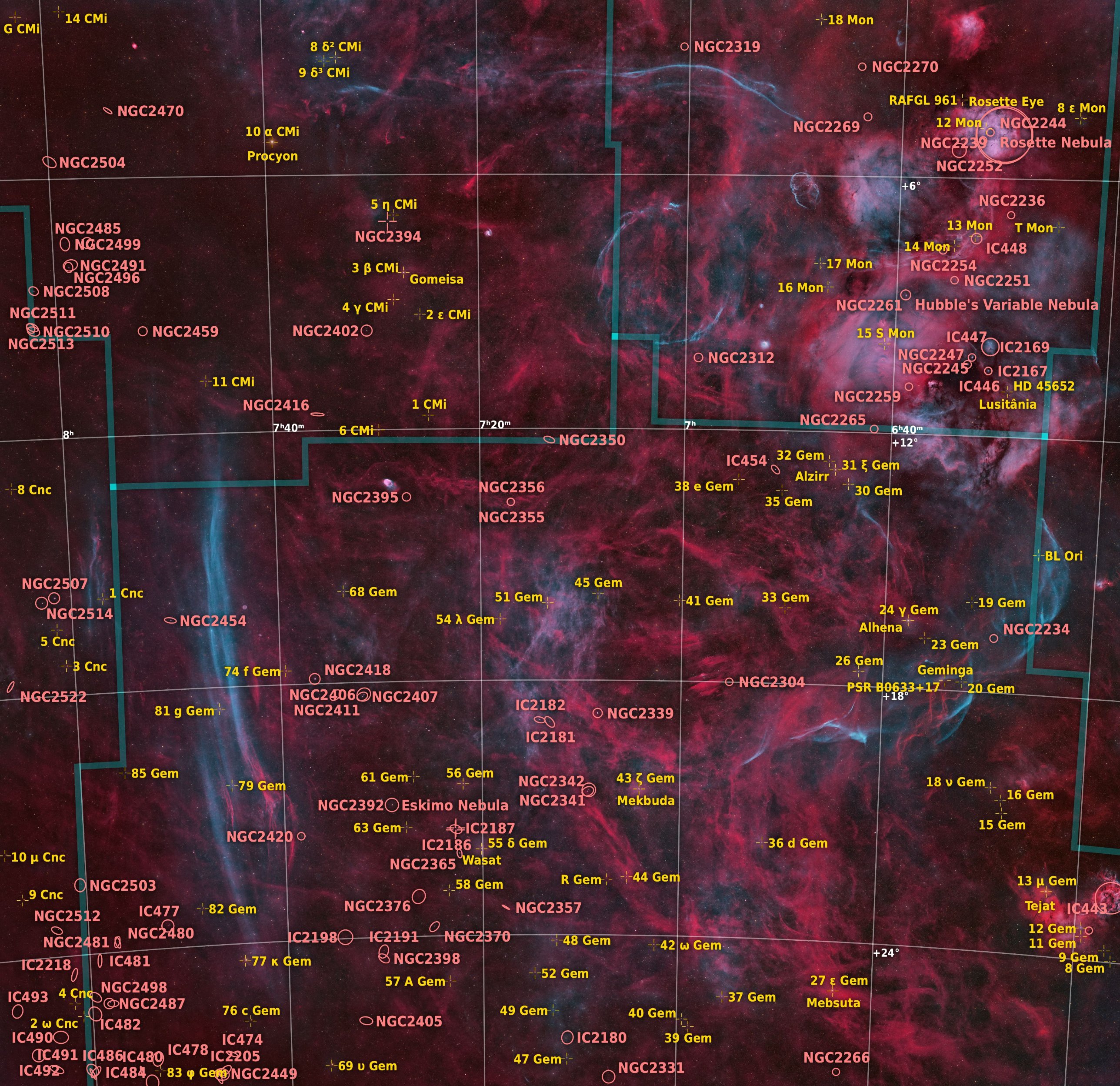
The Monogem Ring is a giant supernova remnant spanning roughly 25° of sky, mainly across Gemini and Monoceros. First noted in X-rays in the 1970s, its ring structure was identified in 1981 by J. A. Nousek and colleagues. It is estimated to lie around 1,000 light-years away with a diameter of roughly 400 light-years, and at an estimated 80,000 to 120,000 years old it has had plenty of time to expand to its enormous apparent size.
The project
This is Team New Horizons’ (NHZ) biggest project yet: a survey of the entire remnant covering about 28° × 28° across four constellations in 54 panels. The project grew out of our HU 6 work, when the team noticed an OIII filament north of HU 6 and traced it to the Monogem Ring. Laurent Huet and Marcel Drechsler had surveyed the region in 2019 and kindly shared their image, which helped us plan the framing.
Imaging began in February 2024 and stretched across three seasons, including reshooting missing and problem panels and waiting three months for Jupiter to move out of the final H-alpha panel. With all the data in by March 2026, Carl Björk assembled the 50,000 × 50,000 pixel mosaic using a custom-written program.
Processing
I took care of the edit. At around 10 GB per channel, the full-scale data was impossible to work with directly, so we downsampled to around 400 megapixels, which pushed my hardware to its limit while keeping maximum detail at about 5″/px for the colour HOO version presented here.
What the data revealed
The mosaic shows the giant, roughly 12° long OIII filament to the north-west, the distinct shock front on the north-eastern edge (where we also found SNR G195.8+02.3), a clear shock front to the south, and a potential blow-out region of HU 6. Technical details draw on an upcoming paper written in collaboration with Robert Fesen.
Integration
H-alpha: 216h / OIII: 216h / Total: 432h, roughly 4 to 6 hours per panel per channel.
Credits
Tim Schaeffer: coordination and data analysis
Steeve Body: editing
Carl Björk: mosaic assembly
Tarun Kottary, Patrick Sparkman and Deepanshu Arora: imaging and stacking
Explore the full-resolution image and acquisition details on AstroBin.