Deer Lick Group & Stephan’s Quintet: Deep Sky Collective Collaboration
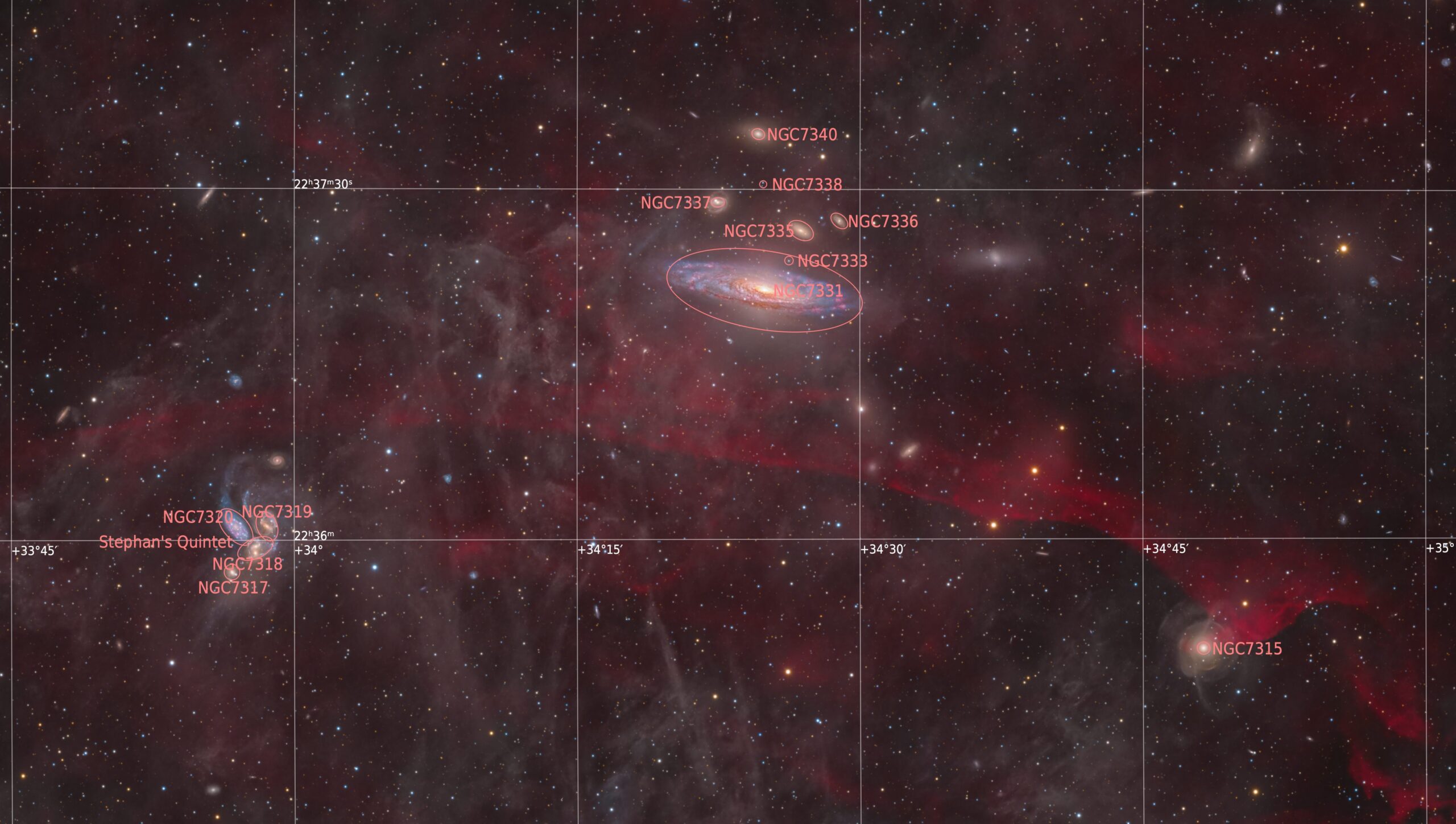
The Deer Lick Group and Stephan’s Quintet sit in the same patch of Pegasus, but they have almost nothing in common physically. NGC 7331, the dominant galaxy in the Deer Lick Group, is about 45 million light-years away. The smaller galaxies flanking it appear nearby on the sky but are actually 300 million light-years further out. Stephan’s Quintet, the first compact galaxy group ever identified when it was catalogued in 1877, adds another layer of complexity to the field.
The H-alpha background
The most unexpected find in this project was a pronounced H-alpha background that until recently had gone largely unnoticed in amateur work. Our science consultant Patrick Ogle was the first to flag it. What emerges in the data is a sharp shock front cutting through the frame, with a distinct H-alpha bulge to one side. The structure may be connected to the Great Lacerta Nebula via stellar winds inflating a large bubble, though the full picture is still being studied.
Pulling that signal out required long sub-exposures, averaging around 1,400 seconds each, with over 350 hours of H-alpha integration total.
IFN and tidal streams
The broadband data tells its own story. More than 130 hours of luminance and 90 hours of RGB brought out the Integrated Flux Nebula threading through the field, faint galactic dust that adds real texture to the background. The same depth revealed blueish tidal streams around Stephan’s Quintet, tracing the gravitational interactions between those galaxies and pointing to active star-forming regions within them.
NGC 7315
One of the quieter highlights is NGC 7315, which displays a halo extending well beyond its visible disc, roughly 385,000 light-years across based on our measurements. It rewards time spent zooming into the high-resolution version.
The project
12 contributors gathered data over about three months starting in late July, followed by another three months of pre- and post-processing. Total integration: 580 hours and 13 minutes, comprising roughly 240 hours of LRGB and 150 hours of H-alpha. It’s the deepest integration the DSC has produced on this target.
My role was editing the final dataset, balancing the faint H-alpha structures against the IFN detail and the broader LRGB layers to bring everything into a single coherent image.
Credits
Tim Schaeffer (coordinator), Adrien Keijzer (stacking), Steeve Body (editing), Patrick Ogle (science consultant), Carl Björk (stacking consultant). Photographers: Akash Jain, Mike Hamende, Ryan Wierckx, John Dziuba, Paul Kent, Bogdan Borz, Antoine & Dalia Grelin, Mark Petersen, Jens Unger.
Carl Björk and Sean Pickard have also put together a pre-processing tutorial now available on the DSC website, covering how data from multiple contributors and systems gets stacked. Worth reading if you’re interested in the collaborative side of this kind of work.
Full image at deepskycollective.com/gallery