


In June 2026, four of us from the Deep Sky Collective and New Horizons teams travelled to Bad Honnef, Germany, to present our work at Galactic Frontiers 2026, a WE-Heraeus seminar on X-ray astronomy. We were there as amateur astrophotographers among professional astrophysicists from around the world, invited to show how a coordinated network of image makers can contribute to the study of supernova remnants and other faint structures in our galaxy.
For me, the week confirmed something I have been working towards for a long time: that image processing, approached as both an art form and a scientific discipline, has a real place in how we see and understand the sky.
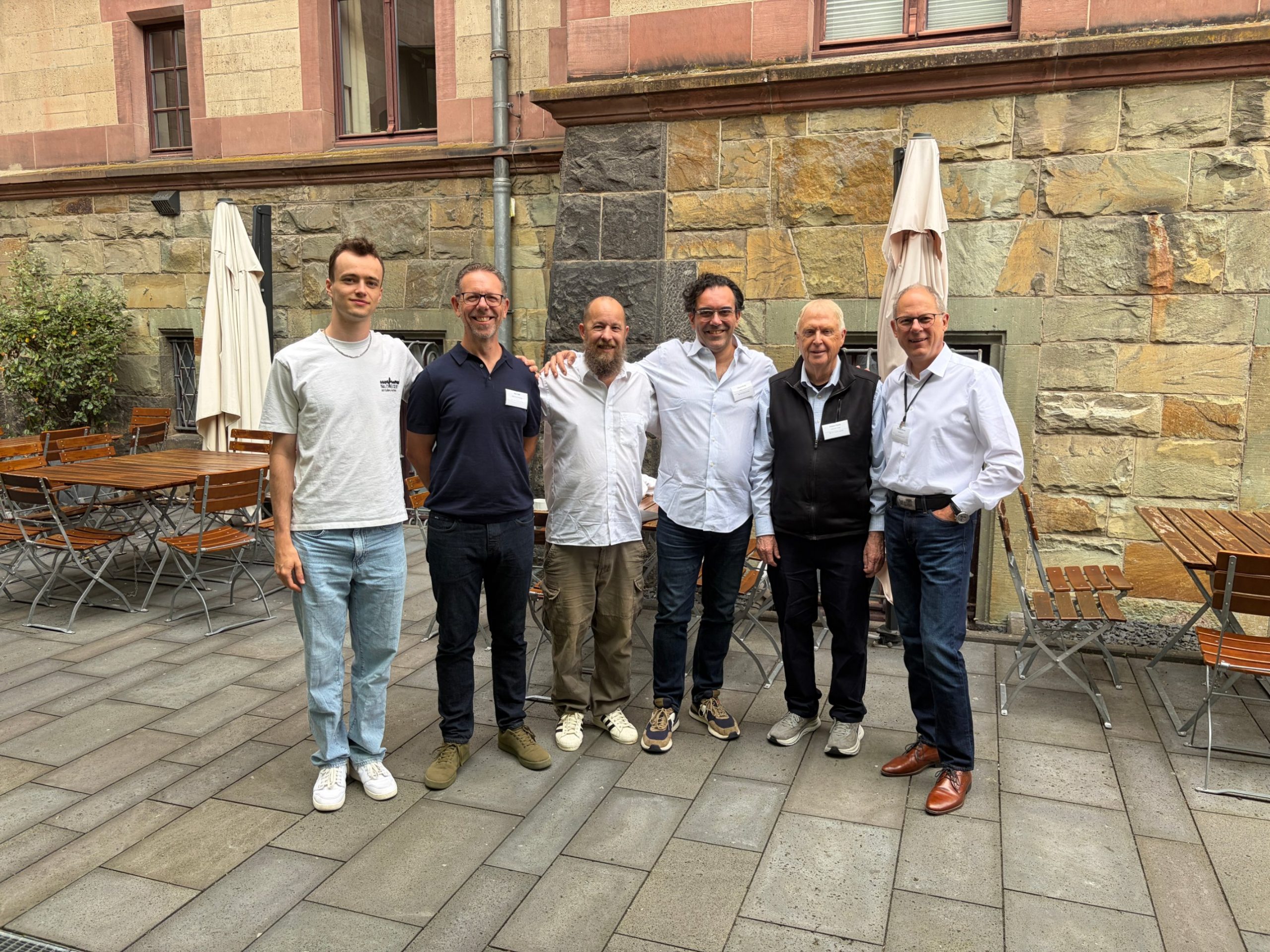
From left: Tim Schaeffer, Ken Hall, Carl Björk, Steeve Body, Dr Robert Fesen and Prof. Dr. Werner Becker
The Seminar
Galactic Frontiers 2026: Advancing X-Ray Astronomy in a Multiwavelength Universe was the 858th WE-Heraeus seminar, held from 14 to 18 June 2026 at the Physikzentrum Bad Honnef. It was funded by the Wilhelm and Else Heraeus Foundation, one of Germany’s main private funders of physics research and education.
The scientific organisers were Prof. Dr. Werner Becker of the Max Planck Institute for Extraterrestrial Physics in Garching, and Prof. Dr. Manami Sasaki of the Dr. Karl Remeis Observatory, Friedrich-Alexander-Universität Erlangen-Nürnberg. Werner, whom we have worked with on the Hoinga supernova remnant, invited us to attend.
The programme centred on Galactic X-ray astronomy and recent results from eROSITA, XMM-Newton, Chandra and XRISM. Talks covered diffuse X-ray emission in the interstellar medium, supernova remnants as sources of energetic particles, and the populations of white dwarfs, neutron stars and black holes. A recurring theme was how X-ray data combines with optical, radio, infrared and gamma-ray observations.
The seminar also explicitly recognised the growing role of international amateur networks in the optical detection of large, degree-wide supernova remnants and nebulae. That is exactly where our work sits.
Our Presentation
We presented as a team, each covering one stage of how a project goes from a faint hint in survey data to a finished, science-ready image. Tim opened by introducing the four roles behind that pipeline:
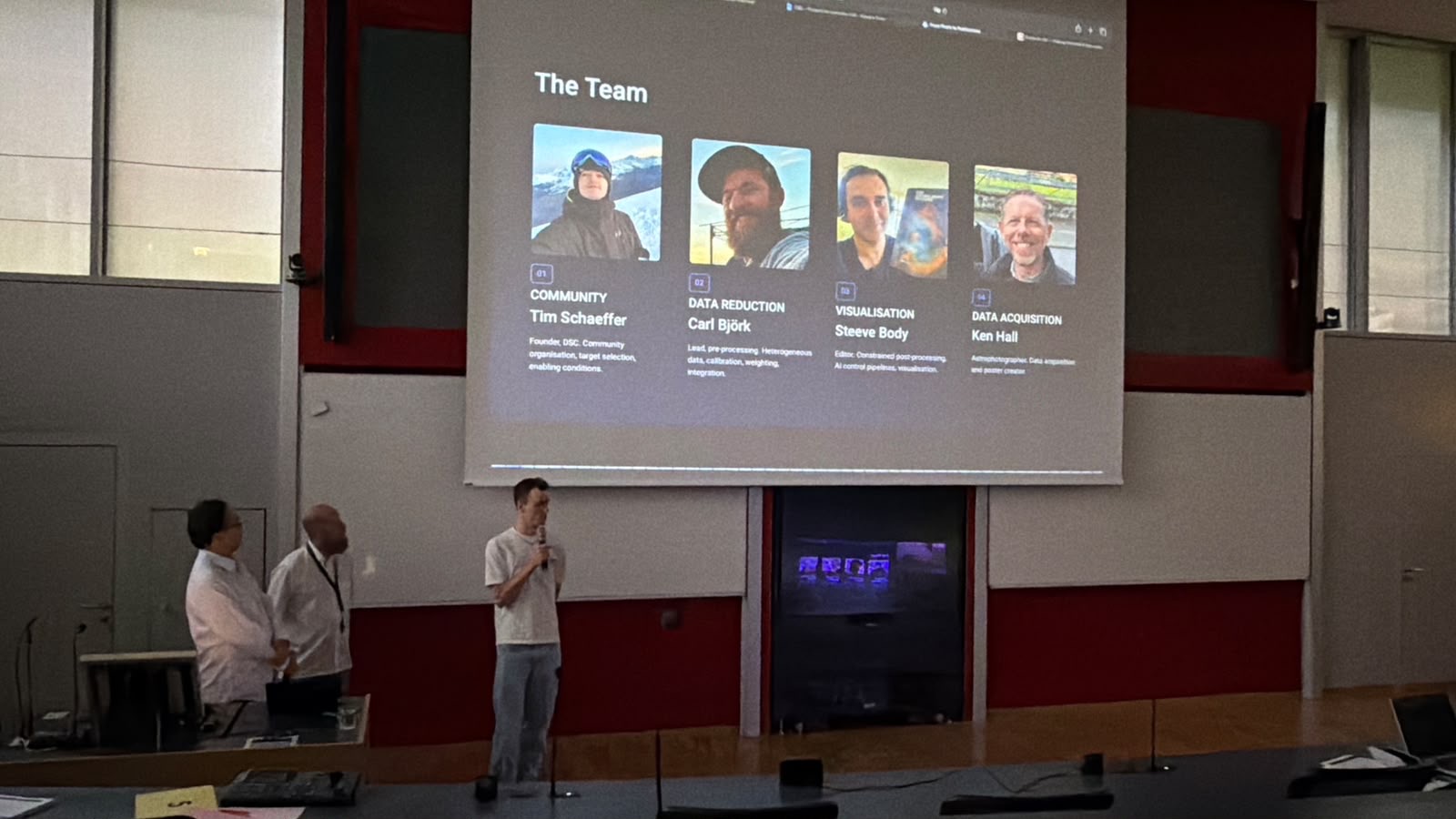
•Community: Tim Schaeffer. Founder of the Deep Sky Collective. Tim handles community organisation and target selection, and creates the conditions that let dozens of photographers work as one team on multi-month campaigns.
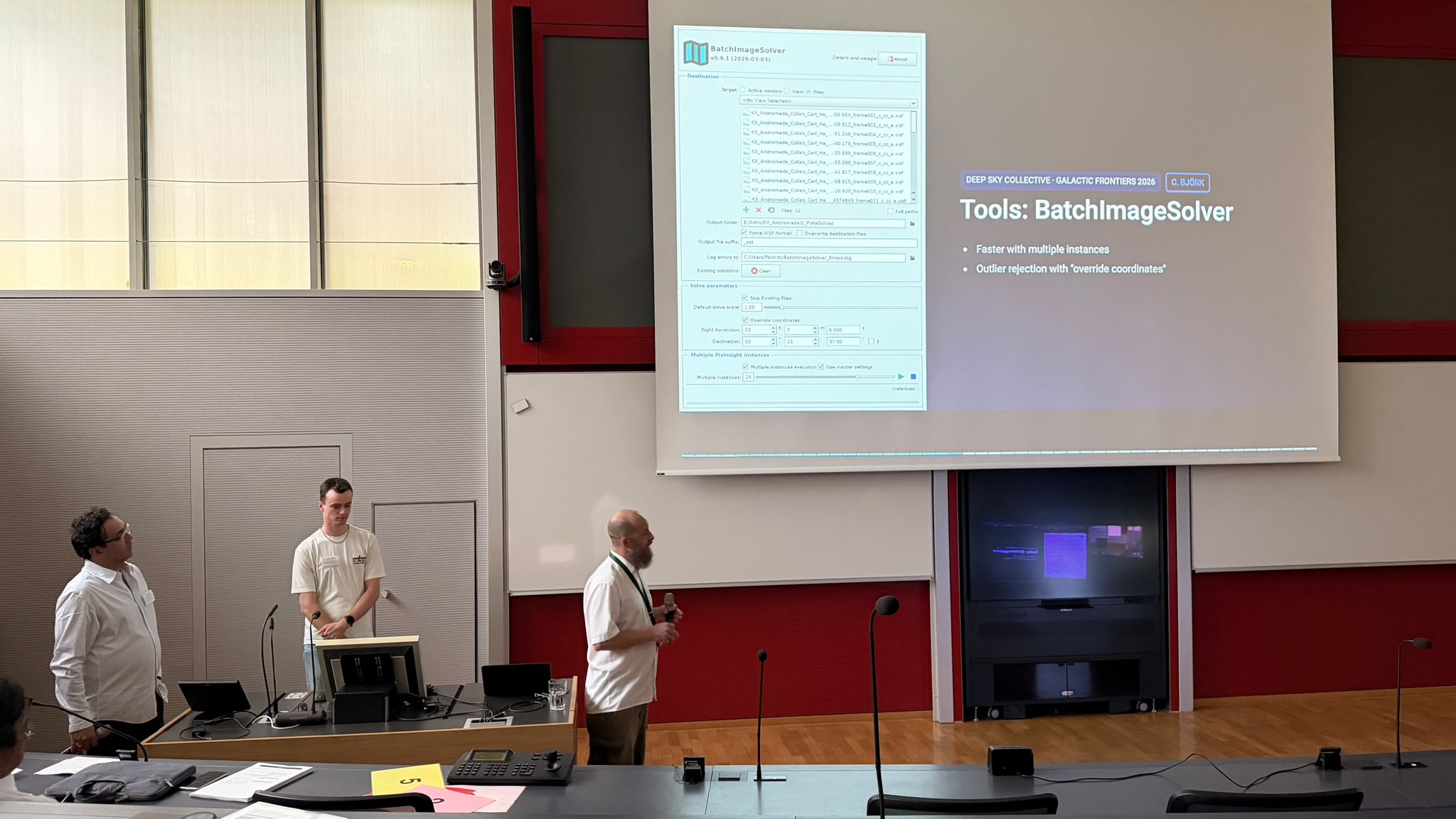
•Data reduction: Carl Björk. Carl leads pre-processing: calibrating, weighting and integrating data from many different telescopes and cameras. He presented BatchImageSolver, a tool he developed that plate solves large batches of frames quickly across multiple PixInsight instances and rejects outliers using known target coordinates.
•Visualisation: Steeve Body. As the team’s editor, I work on constrained post-processing, control pipelines and the final visualisation. I presented our post-processing philosophy, described below.
•Data acquisition: Ken Hall. Ken is an astrophotographer who contributes data to our projects, and he created the poster that went on to win the prize.
Why a Collective Can See What Others Miss
Our main advantage is not any single telescope. It is the network. Through the Deep Sky Collective we can draw on more than 40 astrophotographers worldwide, and pool their data on a single target. That changes what is possible in three ways:
•Integration time. Professional astronomers usually have to win observing time through competitive proposals, and even then rarely receive the hundreds of hours needed to reach the faintest emission. Our M81 and M82 project reached 1,157 hours; the Monogem Ring survey collected 432 hours.
•Field of view. Many of the objects we chase span several degrees of sky. Most professional instruments have a narrow field, while our widefield refractors and full-frame cameras can cover these structures in a manageable number of panels.
•Freedom to explore. Because we are not bound by telescope allocation committees or external funding, we can commit months to a target simply because the data suggests something might be there.
None of this replaces professional observatories. Spectroscopy, X-ray and radio data are what confirm the nature of an object. What we can offer is the deep, wide optical view that points those instruments in the right direction.
Processing as Art and as Data
My part of the talk focused on the idea that processing is where science and art meet. Every decision in the edit, from stretching and colour mapping to how narrowband emission is blended with broadband data, shapes what a viewer can see in the final image.
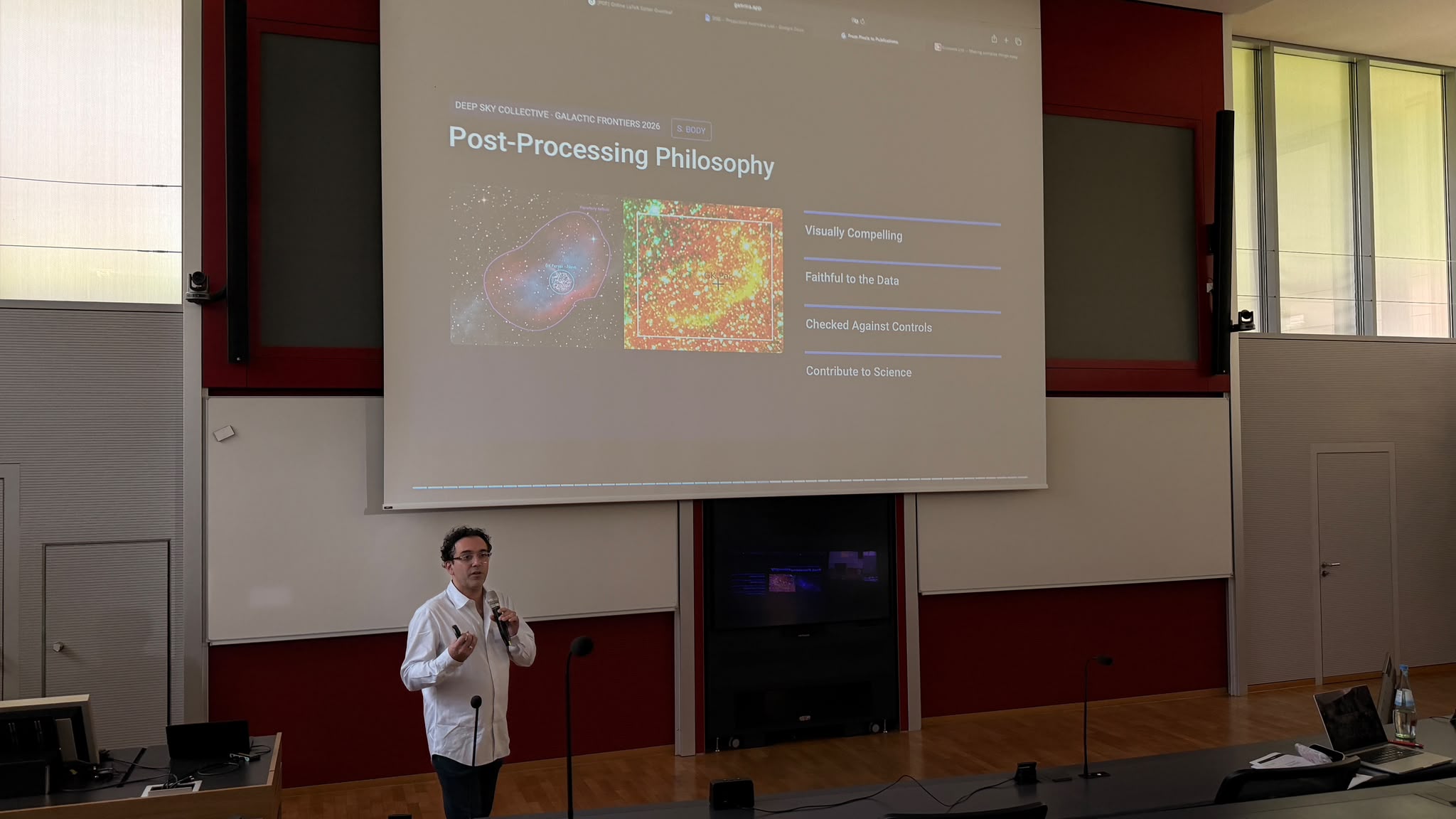
I framed our philosophy around four principles. Every image we release should be:
1. Visually compelling. Colour, contrast and composition guide the eye to the faint shells, filaments and outflows that matter, so that a scientist and a member of the public can both see them.
2. Faithful to the data. Narrowband data is continuum subtracted, so what appears as H-alpha or [O III] emission really is emission, not starlight or background. We avoid processing that could invent or erase structure.
3. Checked against controls. I run a conservative control version alongside the final edit, so any structure in the finished image can be traced back to the data rather than to a tool, including AI-based ones.
4. A contribution to science. The image is a starting point for research, delivered with the calibrated data and notes others need to build on it.
This balance is central to my practice as an artist and to my PhD research at Griffith Film School, which looks at how carefully designed images and immersive experiences can create a sense of awe while staying faithful to the science. Presenting to a room of astrophysicists was a chance to test that idea with the people who use these images as evidence.
From Images to Papers
Our collaboration with the scientific community has already led to published research. Two papers I have co-authored with members of the collective:
•Fesen et al., “Optical Discovery of New and Candidate Galactic Supernova Remnants Plus Optical Imaging of the Monogem Supernova Remnant”. Led by Dr Robert Fesen of Dartmouth College, with co-authors including Werner Becker, it reports five new Galactic supernova remnants and three candidates, found in more than 2,000 hours of H-alpha and [O III] imaging with amateur-class equipment. It also presents our wide-field images of the Monogem Ring.
•Ogle et al., “SDSO1 is a Shocked Ghost Planetary Nebula in Front of M 31”, with Dr Patrick Ogle of the Space Telescope Science Institute.
The Fesen paper makes two points that matter for our approach. Optical surveys can sometimes find supernova remnants that radio and X-ray searches have missed. And faint remnants dominated by [O III] emission may have been overlooked by earlier surveys that looked only in H-alpha. Deep, carefully processed images are what reveal them.
Dr Fesen was at the seminar too, and it was a privilege to meet him in person after collaborating on the Monogem paper.
Best Poster Prize
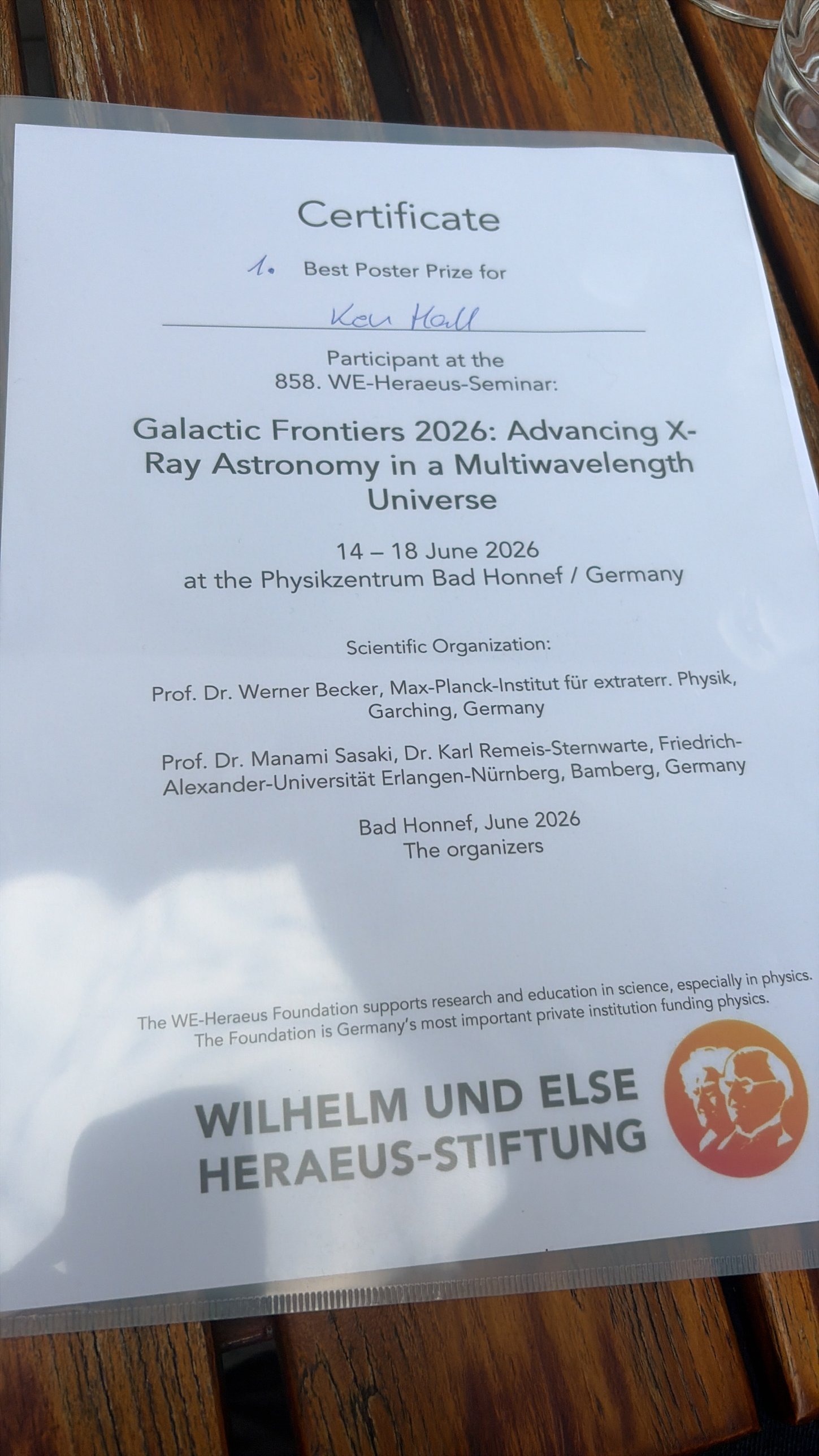
Our poster, “From Survey Hint to Science-Ready Products: HU6 and Hoinga from a Networked Amateur SNR Pipeline”, by Ken Hall, Tim Schaeffer and me for the New Horizons team, won first prize for best poster at the seminar. Ken also presented it to the full room. As his slides put it, faint remnant filaments are wide, diffuse and easy to erase, or invent, during processing, which is why a conservative, documented workflow matters.
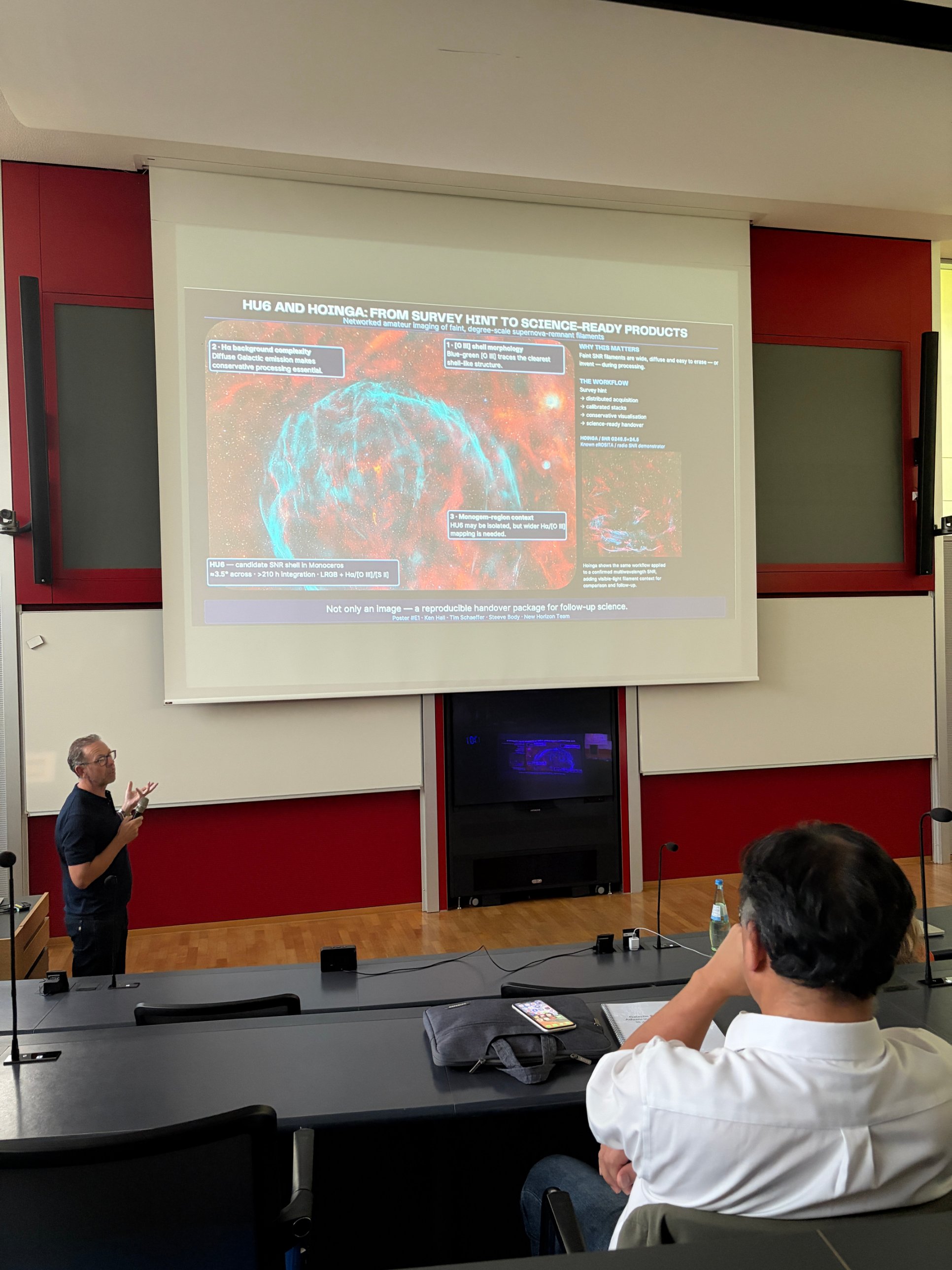
At its centre was my edit of HU6, a faint shell about 3.5° across in Monoceros, imaged by Team NHZ over more than 210 hours in LRGB, H-alpha, [O III] and [S II] as part of our wider survey of the Monogem region. HU6 is treated as a candidate supernova remnant: its shell-like [O III] structure is persuasive, but confirmation needs multiwavelength comparison and spectroscopy. A second panel showed Hoinga (SNR G249.5+24.5), a remnant first identified in eROSITA X-ray data, as an example of how deep optical imaging can add filament detail to a known remnant.
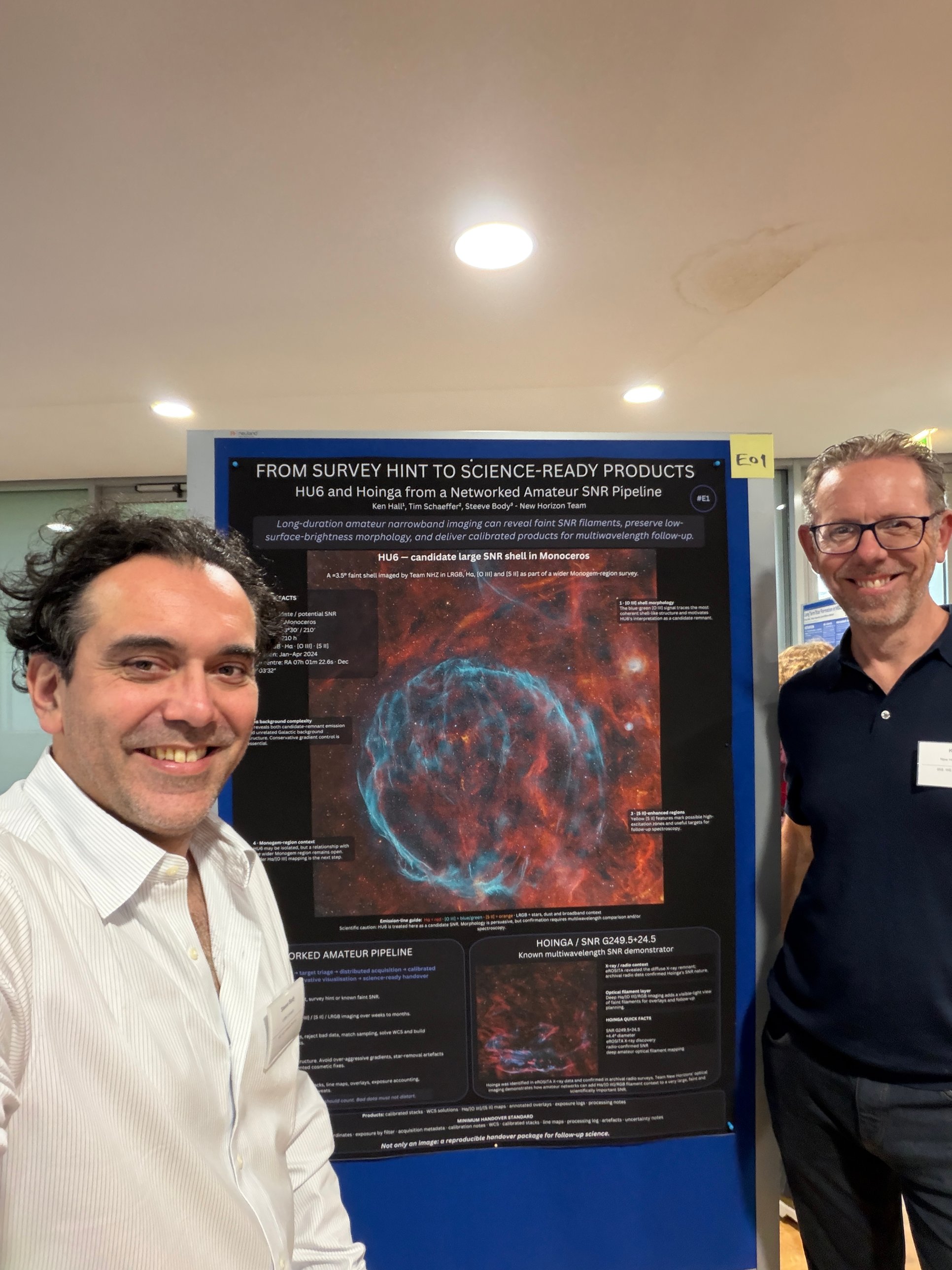
The poster’s message captured the whole week: not only an image, but a reproducible handover package for follow-up science. Alongside the picture, we offer calibrated stacks, coordinate solutions, line maps, exposure logs and processing notes that researchers can build on.
Thank You
Thanks to Werner Becker and Manami Sasaki for the invitation and for organising an outstanding week, to the Wilhelm and Else Heraeus Foundation for supporting it, and to every photographer in the Deep Sky Collective and New Horizons teams whose data makes this work possible.
